Load Brittle And Ductile Crack Propagation
Getting the basics down is all well and good, but when it comes to composing or playing sheet music, Guitar Pro has it licked. Once prepared, you can get started on the individual note library that lets you visualize the fingering as well as listen to how they should sound. Moving on, you can practice the large variety of scales that each come with a plethora of variations. Some of the gizmos included in the software can actually come in useful and let you do everything from one place. The digital guitar tuner and the metronome are extremely handy to have and save you the bother of going out to buy them or of searching through your cluttered room for either. Guitar pro 5.
- Load Brittle And Ductile Crack Propagation Tool
- Load Brittle And Ductile Crack Propagation Software
- Load Brittle And Ductile Crack Propagation Tool
Crack propagation due to brittle and ductile failures in microporous thermoelastoviscoplastic functionally graded materials R.C. Batra., B.M. Modeling crack propagation during the solution of a transient problem by the finite element method (FEM) is very challenging since the crack initiation point and its path are to be determined. Mechanical Properties of Metals II Fracture and Failure 1. Fracture - ductile fracture - brittle fracture - ductile to brittle transition T 2. Fatigue: - fatigue failure - fatigue crack growth rate 3. Creep (time-dependent deformation) - creep rate - Larsen-Miller parameter How to improve mechanical characteristics?
AbstractThe study of break of design materials consists of a amount of technology and engineeringdisciplines. Continuum fracture mechanics is deeply grounded in the issue of fracturebecause it treats the connection between a cráck or inhomogeneity ánd the stréssstate in a materials. Physics and chemistry are essential because they assist to describe thereactions between the atmosphere and the crack suggestion. Finally, components science is definitely essentialin knowing the relations among bond rupture, construction, digesting and performanceof a material.Fracture of materials can end up being separated into two wide classes - ductile and brittlefracture. Ductile fracture is linked with significant plastic material deformation. 'Glass andcone' fracture confirmed in alloys credited to tensile overburden is certainly a classic example of ductilefracture.
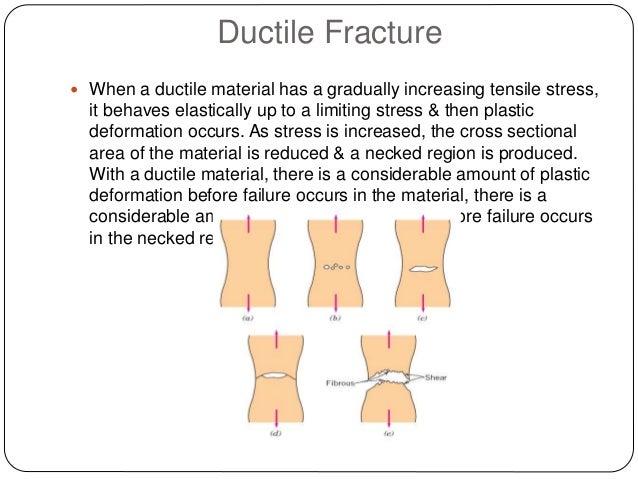
The different levels of like fracture are demonstrated in Number l.l(a). At the maximumload, plastic deformation is certainly focused in a small gage size of the specimen andnecking starts. As soon as this necked area has produced, fracture starts at the middle of thespecimen and extends along the dashed lines, finally producing the acquainted cup and conefracture. In fcc materials, plastic material deformation continues on the conjugate slip aeroplanes until thespecimen provides necked down to a sharp stage. Polycrystalline metals with second stage particlesfail credited to initiation, development and coalescence óf micro-voids formed in the necked area. Likewise, semicrystalline polymers show necking which qualified prospects to localizedstrengthening óf the specimen.
Load Brittle And Ductile Crack Propagation Tool
Then the specimen elongates owing to the própagation of thisneck aIong the gage size. This ductile fracture in polymers is definitely different from thát in metaIs,in which aIl following deformation is usually limited to the neck of the guitar region.Alternatively, brittle stress fracture is related with little ór no déformation. A brittle materiaIbehaves elastically up to the optimum insert at which devastating failure occurs (Fig.1.1(c )). Silicate glasses are the nearly all common illustration of such break. Brittle fractureis managed by tiny inclusions, surface area and inside defects and flaws and porespresent in the material. An intermediate class of bone fracture, recognized as quasi-brittlefracture, provides recently been recently defined. A quasi-brittle material, a title which encompassesmany poIycrystalline ceramics and cémentitious components, shows measurable deformationprior to failure.
Load Brittle And Ductile Crack Propagation Software
The deformation, however, is not really related with dislocation movement. Atthe onset of nonIinearity in the Ioad-displacement connection existing imperfections in the materialstart growing and brand-new flaws type (Fig. Like materials are usually characterized by asoftening shape after the top fill. This softening department of the Ioad-displacement relationshipis related with stable crack growth in the materials before the final stress fracture. Thefailed specimen, however, need not appear any different from a classically-brittle hit a brick wall specimen.In a review article like as this, it will be helpful to initial build the necessary background, andvarious aspects of fracture mechanics are usually analyzed in the following section. This review is followedby conversations of the microstructural aspects of toughening systems, brief crackfracture in comparison to lengthy crack fracture, the statistical character of bone fracture and its impIicationsfor quasi-brittle components, and sluggish crack development and additional environmental effectson different fracture procedures are introduced.
The effects to cementitious materialsare discussed throughout.Product Kind:Book SectionAdditional Details:© 1993 Us Ceramic Community.Record Quantity:CaltechAUTHORS:20138556Persistent URL:Usage Plan:No commercial reproduction, distribution, screen or overall performance rights in this function are provided.ID Code:49866Collection:CaltechAUTHORSDeposited By:George PorterDeposited On:20 Sep 2014 02:05Last Modified:20 Sep 2014 02:05Repository Personnel Only.
Load Brittle And Ductile Crack Propagation Tool
. 4.2k Downloads.AbstractThe systems of fatigue-crack propagation are examined with specific importance on the similarities and variations between cyclic crack growth in ductile materials, such as alloys, and corresponding behavior in brittle materials, such as intermetallics ánd ceramics. This is usually accomplished by taking into consideration the process of fatigue-crack growth as a mutual competitors between inbuilt mechanisms of crack advance forward of the crack tip (y.g., switching crack-tip bIunting and résharpening), which advertise crack development, and extrinsic systems of crack-tip protecting behind the suggestion (elizabeth.h., crack drawing a line under and bridging), which slow down it. The widely differing nature of these mechanisms in ductile and brittle components and their particular reliance upon the alternating and optimum driving energies (at the.g., Δ E and T utmost) supply a useful variation of the process of fatigue-cráck propagation in different classes of components; moreover, it offers a rationalization for the impact of like factors as fill percentage and crack dimension. Lastly, the differing susceptibiIity of ductile ánd brittle materials to cyclic degradation has broad effects for their potential structural software; this will be briefly discussed with reference point to lifetime prediction.